
As California politicians promote anti-oil agendas, a major new study by top researchers from UC Berkeley and the University of Southern California urges Federal action to bypass these policies on national security grounds
By Eric Eisenhammer,
Director of Public Affairs and Public Relations
California has quickly become the flashpoint in a battle for the rights of oil and gas royalty owners. Royalty owners submitted public comments opposing a proposed Santa Barbara County oil ban and then showed up in force to the Board of Supervisors meeting in Santa Maria to deliver testimony.
The ban, which NARO-California is committed to fighting, was approved on a 3-2 vote, raising serious Constitutional issues about Fifth Amendment protections against the taking of private property without compensation. Further concerns were raised about compliance with CEQA, the California Environmental Quality Act.
Meanwhile, a major new study was released calling California’s anti-oil policy a national security crisis and noting that California could produce up to 1.1 million barrels of oil a day were it not for Sacramento’s counterproductive policies. That would amount to a 5X increase from California’s current production level of 200,000 to 250,000 barrels a day.
Santa Barbara County’s oil ban is called the Phase I Onshore Oil and Gas Prohibition. This first phase aims to ban new oil wells. The County is planning a second phase that phases out current production through a process called “amortization,” or a timeline for the shutdown of wells with no compensation.
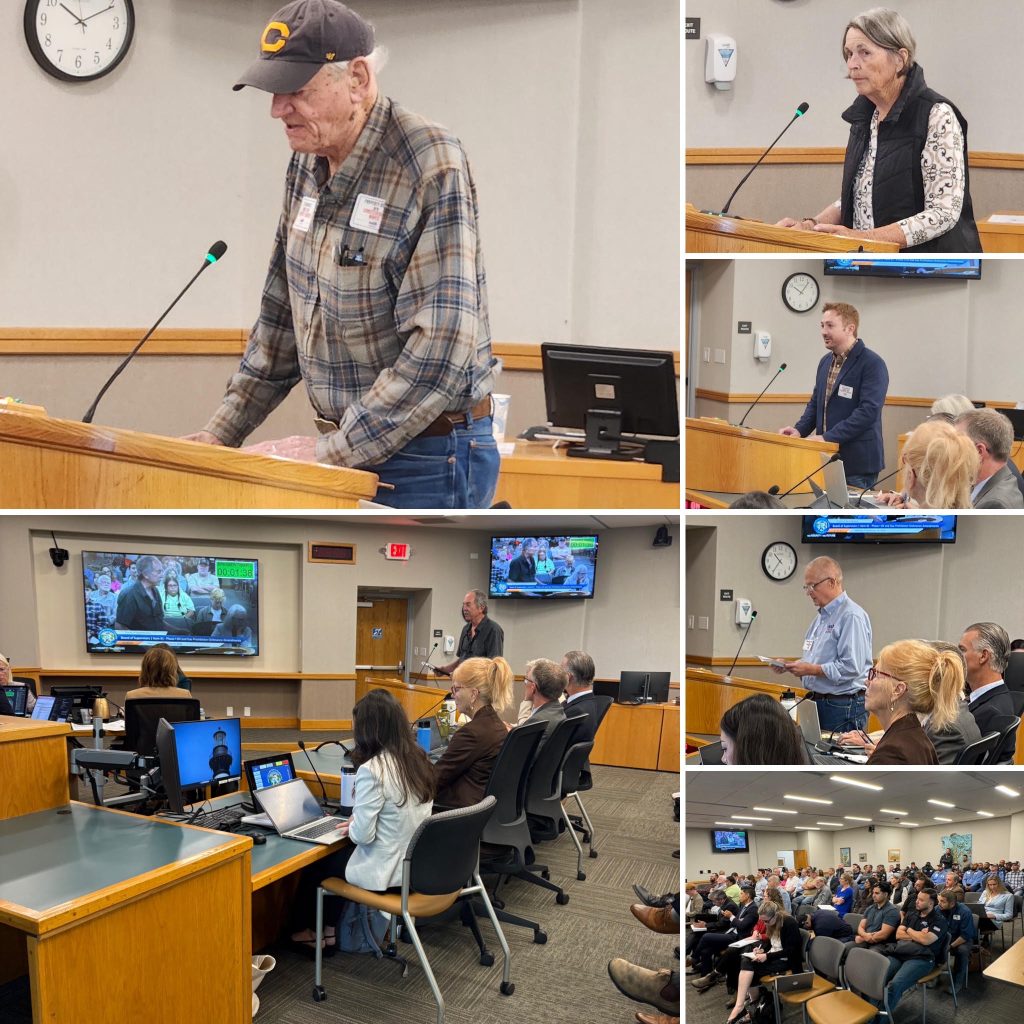
Royalty owners represented at the hearing included seniors, farmers, and ranchers, as well as myself speaking as NARO-California’s Director of Public Affairs and Public Relations and our President, Ed Hazard. I presented the Board of Supervisors with petitions signed by over 200 oil and gas royalty owners, supporters, and Santa Maria’s mayor and a good friend of NARO-California, Alice Patino.
NARO-California President Ed Hazard, whose family are Santa Barbara County mineral and royalty owners, focused his remarks on the property rights and constitutional concerns raised by the proposed ban. He explained that mineral rights cannot simply be relocated and warned that phasing out production through “amortization” does not compensate royalty owners for resources they would be forced to leave underground. Hazard also pointed to NARO-California’s successful involvement in the challenge to Monterey County’s Measure Z and raised concerns about the County’s environmental review, including the impacts of replacing local production with imported oil.
Supervisor Bob Nelson’s questions revealed County planners failed to consider numerous important issues including whether the ban would impact petroleum demand locally or statewide, where its replacement would come from, and what environmental impacts would occur due to increased oil imports. Furthermore, these questions revealed the county’s environmental planning documents state oil production provides an important contribution to the county’s economy and should be encouraged.
Santa Barbara County’s oil ban is called the Phase I Onshore Oil and Gas Prohibition. This first phase aims to ban new oil wells. The County is planning a second phase that phases out current production through a process called “amortization,” or a timeline for the shutdown of wells with no compensation.
Royalty owners represented at the hearing included seniors, farmers, and ranchers, as well as myself speaking as NARO-California’s Director of Public Affairs and Public Relations and our President, Ed Hazard. I presented the Board of Supervisors with petitions signed by over 200 oil and gas royalty owners, supporters, and Santa Maria’s mayor and a good friend of NARO-California, Alice Patino.
NARO-California President Ed Hazard, whose family are Santa Barbara County mineral and royalty owners, focused his remarks on the property rights and constitutional concerns raised by the proposed ban. He explained that mineral rights cannot simply be relocated and warned that phasing out production through “amortization” does not compensate royalty owners for resources they would be forced to leave underground. Hazard also pointed to NARO-California’s successful involvement in the challenge to Monterey County’s Measure Z and raised concerns about the County’s environmental review, including the impacts of replacing local production with imported oil.
Supervisor Bob Nelson’s questions revealed County planners failed to consider numerous important issues including whether the ban would impact petroleum demand locally or statewide, where its replacement would come from, and what environmental impacts would occur due to increased oil imports. Furthermore, these questions revealed the county’s environmental planning documents state oil production provides an important contribution to the county’s economy and should be encouraged.
In addition to oil and gas royalty owners, oil workers, and producers who attended the hearing, attorney Jeff Jennings of Pacific Legal Foundation, who is currently representing two NARO-California members with mineral rights in Santa Barbara County, joined the meeting to testify that an oil ban would violate the Fifth Amendment.
Underscoring and quantifying the severity of the harm the oil ban presents, John Harris, president of highly respected geoscience and engineering firm Numeric Solutions, whom NARO-California has engaged, testified that the value of oil and gas royalties impacted by the policy could be in excess of $1 billion. That does not include business enterprise value to producers that could be at least two to three times more. Central Coast Taxpayers Association comments submitted in opposition noted taxpayers could ultimately be on the hook for these liabilities if the County moves forward.
Mike Stoker, who serves as President & CEO of the Santa Barbara County Taxpayer Advocacy Center and who is both a former Santa Barbara County Supervisor and former Southwest Administrator of the U.S. Environmental Protection Agency furthermore showed up to testify about the policy’s lack of a logical basis. Stoker stated
“The day may come that we run on wind, tidal and solar. But that day isn’t here now, and until it is you have two choices, foreign oil or California oil.”
Santa Barbara County’s plan represents one of two competing visions for American energy policy.
Nationally, Federal policy is working for energy dominance — a policy that encourages domestic oil and gas production.
The case for such a policy was recently strengthened by a major new study titled Addressing U.S. National Security Vulnerabilities Created by California Oil and Refinery Policies: The Need for a Rapid Response Fuel Reserve, which was authored by Michael Mische of USC, James Rector of UC Berkeley and Joseph Silvi, a Berkeley graduate and graduate research assistant.
The study states that California’s misguided energy policy has created a national security vulnerability that threatens U.S. military readiness in the Pacific. The researchers urge policymakers to use the presidential and federal authority under the Defense Production Act of 1950 for Executive Orders to authorize new oil drilling and tackle California’s severe need for expanded refinery and pipeline capacity. The report validates concerns raised in a recent letter to national policymakers by NARO-California.
Abundance or shortages and price spikes? Those are the two competing energy visions. NARO-California stands on the side of abundance.
And today, Santa Barbara County sits at the center of that choice.
Santa Barbara County may be one local battleground, but the questions raised here reach far beyond county lines: the future of domestic energy production, the security of private property rights, and the legacy passed from one generation of mineral owners to the next.
If you have minerals or royalties in Santa Barbara County, we’re asking you to join us as a plaintiff in a pending lawsuit. You’ll be joining many other royalty owners who have already signed on.
Some are supporting this lawsuit with monthly donations, but you don’t need to donate to be a plaintiff. Being a plaintiff is a statement saying, “this affects me and I’m fighting back to defend my rights.” Call us at (661) 210-3025 or send us an email at info@naro-ca.org and we’ll get you signed up. The process is straightforward, and it makes a difference.
We also are deeply appreciative of the many royalty owners who are stepping up as NARO-California sponsors. We have set an initial target of raising $200,000 and your donations and commitments so far already have us over halfway to the goal.
This fight is bigger than Santa Barbara County. What happens here could shape energy and property-rights battles far beyond California.
Please consider partnering with us as a NARO-California sponsor.
If you’re already a sponsor, consider stepping up to the next sponsorship level to help us stand strong to defend your oil and gas mineral rights — and your family legacy.
The fight over the Santa Barbara County oil ban is only just beginning, and we have won similar fights before. We are committed to defending the rights of royalty owners, and we are confident we will once again prevail.

Eric Eisenhammer
Eric serves as Public Affairs and Public Relations Director for NARO-California. He's a Southern California native with a bachelor's degree in Finance and a background in small business and taxpayer advocacy.